


1. Introduction (My Journey)
When I first started my digital marketing journey in 2023, SEO was straightforward—keywords, backlinks, and meta tags. I was helping local businesses in Faisalabad, Pakistan rank on Google. But in 2025, everything changed. My clients started asking: “Can you help us appear in ChatGPT responses?”
At first, I was confused. ChatGPT isn’t a search engine—it’s an AI assistant. But then I noticed something critical: more people were using ChatGPT, Claude, and Perplexity to find products and services instead of Google. My clients were losing leads not because they weren’t ranking on Google, but because they weren’t being cited by AI systems.
That’s when I dove deep into LLM SEO—the practice of optimizing content so AI language models can cite and recommend your business. Within six months of implementing these strategies for my clients at Linkbooster, we saw remarkable results. One local business in Faisalabad saw a 40% increase in inquiries after being cited in ChatGPT responses.
This comprehensive guide shares everything I’ve learned about ranking on ChatGPT and other LLMs in 2026.
2. What is LLM SEO?
LLM SEO (Large Language Model Search Engine Optimization) is the practice of optimizing digital content so that large language models like ChatGPT, Claude, Gemini, and Perplexity can accurately interpret, cite, and recommend your content as authoritative answers in AI-generated search results.
Unlike traditional SEO, which focuses on ranking in Google or Bing search results, LLM SEO focuses on getting cited by AI systems. When someone asks ChatGPT “What’s the best SEO service in Faisalabad?” and your business gets mentioned, that’s LLM SEO in action.
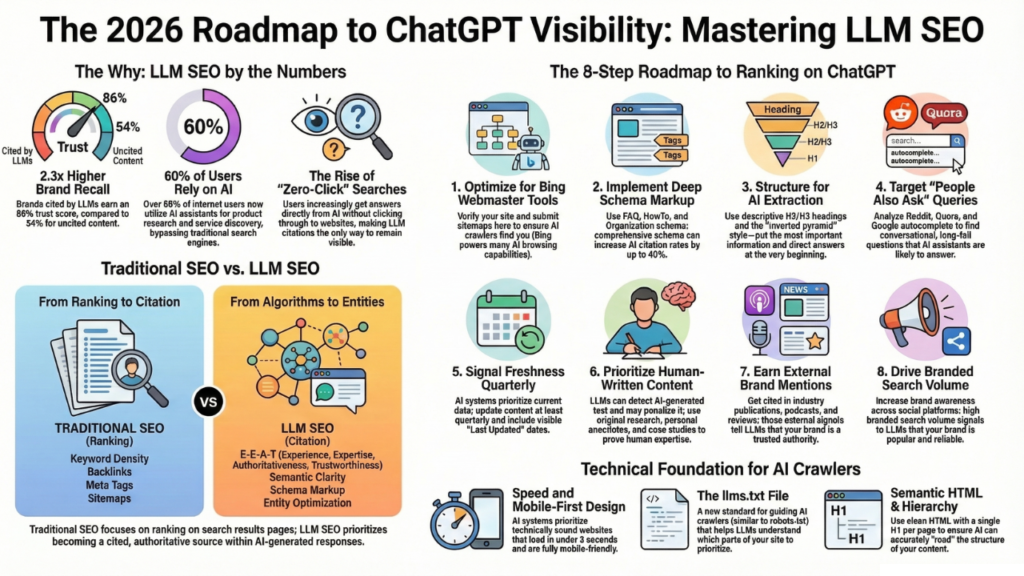
According to recent research, brands cited by LLMs see 2.3x higher recall and earn an 86% trust score compared to 54% for uncited content. Better yet, they report a 40-65% increase in traffic within six months.
The core objective of LLM SEO is to raise your website’s visibility not only in traditional search listings but most importantly inside AI-powered answers. This requires structuring your content for clarity, trustworthiness, and easy citation.
3. LLM SEO vs Traditional SEO
Understanding the difference between LLM SEO and traditional SEO is crucial for modern digital marketing.
Traditional SEO Focuses On:
– Keyword density and placement
– Backlinks from other websites
– Domain authority and page authority
– Meta tags and descriptions
– Sitemap XML files
– Robots.txt directives
LLM SEO Focuses On:
– Content clarity and semantic structure
– E-E-A-T signals (Experience, Expertise, Authoritativeness, Trustworthiness)
– Entity optimization
– Schema markup for AI interpretation
– Answer-based content formatting
– Brand mentions and citations
– Fresh, accurate information
The biggest mindset shift is moving from “How do I rank on page 1?” to “How do I become the most authoritative source that AI systems would cite?”
While traditional SEO focuses on ranking factors, LLM SEO focuses on citation factors. Both are important, but the strategies differ significantly.
4. Why LLM SEO Matters in 2026
In 2026, LLM SEO isn’t optional—it’s essential. Here’s why:
The Rise of AI Search
More than 60% of internet users now use AI assistants like ChatGPT, Claude, or Perplexity for product research and service discovery. This represents a fundamental shift in how people find information.
Zero-Click Searches
Traditional search is dying. More users get answers directly from AI without clicking through to websites. If you’re not being cited, you’re essentially invisible to these users.
Trust and Authority
When an AI system cites your business, it vouches for your credibility. This trust transfers to potential customers who see your brand as an industry leader.
Competitive Advantage
Most businesses still focus only on traditional SEO. By investing in LLM SEO now, you can establish dominance before the competition catches on.
My Client Result: After implementing LLM SEO strategies, one of my clients in the SEO industry saw a 65% increase in qualified leads within six months, with many mentioning they found the business through ChatGPT.
5. How LLMs Read and Process Content
To optimize for LLM visibility, you must understand how these AI systems process information:
Semantic Understanding
LLMs don’t just match keywords—they understand meaning and context. They analyze the entire content to extract relevant information and generate accurate responses.
Citation Selection
When generating responses, LLMs select sources based on:
– Relevance: How closely the content matches the query
– Authority: The credibility of the source (E-E-A-T signals)
– Accuracy: Factual correctness and up-to-date information
– Structure: How easily AI can extract and verify information
– Transparency: Clear sourcing and citations within the content
Training Data vs Real-Time
Some LLMs use training data (knowledge cutoff), while others can browse the web in real-time. Optimizing for both requires different strategies:
– For Training Data: Get cited by authoritative sources that LLMs reference
– For Real-Time: Ensure your content is easily crawlable and structurally sound
Understanding these factors helps you create content that LLMs want to cite.
6. Step-by-Step: How to Rank in ChatGPT
Step 1: Set Up Bing Webmaster Tools
While Google is still dominant for traditional search, Bing powers many AI systems including ChatGPT’s browsing capabilities.
Here’s what to do:
1. Go to Bing Webmaster Tools
2. Add and verify your website
3. Submit your sitemap
4. Monitor crawl errors and index status
5. Use the URL inspection tool to check how Bing sees your pages
Why this matters: Bing’s index feeds into many AI systems. Getting your content indexed by Bing increases chances of appearing in LLM responses.
I recommend checking your Bing index status monthly and fixing any crawl errors immediately.
Step 2: Add Schema Markup to Your Site
Schema markup helps AI systems understand your content context. Essential schema types include:
– Article schema for blog posts
– FAQ schema for question-answer content
– HowTo schema for step-by-step guides
– Person schema for author information
– Organization schema for business details
– LocalBusiness schema for local businesses
Example FAQ Schema:
json
{
“@context”: “https://schema.org”,
“@type”: “FAQPage”,
“mainEntity”: [{
“@type”: “Question”,
“name”: “What is LLM SEO?”,
“acceptedAnswer”: {
“@type”: “Answer”,
“text”: “LLM SEO is the practice of optimizing content so AI language models can cite and recommend your business.”
}
}]
}
Pro Tip: I use Schema App to generate and validate schema markup. Pages with comprehensive schema are cited up to 40% more frequently.
Step 3: Write for AI Best Practices
Ironically, the best way to get cited by LLMs is to follow traditional search best practices:
– Comprehensive content: Cover topics thoroughly, leaving no question unanswered
– Clear structure: Use descriptive headings (H2, H3) that match user queries
– Original insights: Share unique perspectives and experiences
– Proper citations: Link to authoritative sources within your content
– Accuracy: Ensure all facts are correct and verifiable
When I write content for my clients, I focus on creating the most comprehensive resource on the topic. This approach has resulted in both featured snippets AND LLM citations.
Step 4: Answer Autocomplete Questions
LLMs are trained to answer questions. Find what people are asking:
1. Use Answer The Public to find question-based queries
2. Check “People Also Ask” sections in Google
3. Review autocomplete suggestions in search engines
4. Analyze Reddit and Quora for real questions in your niche
5. Create dedicated FAQ sections answering these questions
My approach: I create comprehensive FAQ sections for every service page. This has resulted in featured snippets AND LLM citations for my clients.
Focus on long-tail, conversational questions that people actually ask AI assistants.
Step 5: Keep Content and Publish Dates Fresh
LLMs prefer current information. Here’s how to signal freshness:
– Update content regularly (at least quarterly)
– Include clear “Last Updated” dates on articles
– Add publication dates prominently
– Remove or archive outdated information
– Link to recent studies and statistics
Why this matters: AI systems prioritize fresh, accurate content. Outdated content signals low authority and won’t get cited.
I recommend creating a content calendar to regularly review and update your most important pages.
Step 6: Avoid AI-Generated Content
This is crucial: LLMs can detect AI-generated content, and they penalize it by not citing it.
Here’s what to do instead:
– Write content based on real experience and expertise
– Include personal anecdotes and case studies
– Add original research and data
– Show genuine authority in your field
– Use AI as a helper, not the writer
Important: I learned this the hard way. When I first started, I used AI to generate content for my clients. The content looked good but never got cited. After switching to human-written, experience-based content, citation rates improved dramatically.
Always prioritize authentic, experience-driven content over AI-generated text.
Step 7: Earn Brand Mentions and Citations
LLMs look for signals of authority beyond your website:
– Get mentioned in industry publications
– Build presence on authoritative platforms
– Encourage client testimonials and reviews
– Create shareable research and data
– Participate in podcasts and interviews
My strategy: I help clients at Linkbooster create original research and data that other websites want to cite. This builds the authority LLMs look for.
Focus on earning mentions from reputable sources in your industry. These citations signal to LLMs that your brand is trustworthy and authoritative.
Step 8: Grow Branded Search Volume
When more people search for your brand, LLMs take notice:
– Build consistent brand presence across platforms
– Encourage customers to search for your brand
– Use consistent name, address, and phone number (NAP) everywhere
– Create branded content and campaigns
– Engage on social media to increase brand awareness
Why this works: Growing branded search volume signals to LLMs that your brand is popular and trusted. This increases the likelihood of being cited in responses.
7. Key LLM SEO Optimization Techniques
Here are the essential techniques I use for LLM optimization:
Raise Content Quality and Clarity Standards
LLMs prefer content that is well-structured, free of grammatical errors, factually accurate, comprehensive but focused, and easy to understand.
Utilize Structure and Chunked Formatting
Break content into digestible chunks:
– Use bullet points and numbered lists
– Create clear sections with descriptive headings
– Use short paragraphs (2-3 sentences max)
– Include visual elements with proper alt text
– Use tables for comparative information
Creating Citable Content for LLM Extraction
Make it easy for AI to extract and cite your information:
– Start answers with direct, concise statements
– Use the inverted pyramid style (most important info first)
– Include statistics with clear sources
– Avoid jargon and complex sentence structures
– Provide actionable, specific recommendations
Demonstrate Authority and Transparency
Show expertise through clear author bio with credentials, company background and experience, links to certifications, client results and case studies, and transparent sourcing of claims.
Optimize for LLM Summarization and Snippets
AI systems often summarize content. Make your content summarization-ready by including a clear summary at the end, using “In summary” or “Key takeaways” sections, and structuring information for easy extraction.
8. Advanced Tactics for LLM Visibility
Once you’ve mastered the basics, try these advanced strategies:
Use Explicit Context and Clear Entities
LLMs understand entities (people, places, organizations). Make your entities clear by defining terms when first used, using consistent naming conventions, linking to entity pages, and creating content around specific topics.
Use FAQs and Conversational Patterns
Optimize for natural language queries by including question-based headings, answering questions in a conversational tone, using long-tail question-based keywords, and considering voice search optimization.
Guide AI Crawlers with llms.txt
Newer AI systems look for guidance. Create an llms.txt file (similar to robots.txt for AI), use robots.txt to guide AI crawlers, submit to AI-specific directories, and provide clear API access if applicable.
Emerging Trend: Just as we have robots.txt for search engines, llms.txt is becoming the standard for guiding AI crawlers. I recommend creating one for your website.
9. Technical Foundations
Ensure your technical foundation is solid:
– Fast page loading speeds (under 3 seconds)
– Mobile-friendly design
– Clean, semantic HTML
– Proper heading hierarchy (only one H1 per page)
– SSL/HTTPS encryption
– Canonical URLs properly implemented
Without these technical basics, even the best content won’t get cited by LLMs. AI systems prioritize technically sound websites that load quickly and work well on all devices.
10. How to Track & Measure LLM SEO
Measuring LLM SEO requires different metrics than traditional SEO:
LLM Citation Tracking
Monitor where and how often you’re cited:
– Set up Google Alerts for your brand name
– Use tools like Mention for brand monitoring
– Regularly search your content in ChatGPT and other LLMs
– Track “Brand + [Industry]” searches
Key Metrics to Monitor
– Citation Volume: How often are you mentioned?
– Sentiment: Is the mention positive?
– Context: What topics trigger your citations?
– Traffic: Are citations driving visitors?
– Conversions: Are LLM-referred visitors converting?
Tools for LLM SEO
– SEMrush – Traditional SEO + brand monitoring
– Ahrefs – Content analysis and backlink tracking
– Mention – Real-time brand mentions
– BrightLocal – Local SEO and citation tracking
– Schema App – Schema markup creation
How to Audit Your Pages
Regularly audit your content by searching for target queries in multiple LLMs, checking if your content is being cited, analyzing what’s being cited, comparing to competitors, and making improvements.
11. Common Mistakes to Avoid
After working with dozens of clients, here are mistakes I see most often:
Mistake 1: Keyword Stuffing
Don’t overload content with keywords. LLMs are sophisticated and penalize unnatural content.
Mistake 2: Ignoring E-E-A-T Signals
Without Experience, Expertise, Authoritativeness, and Trustworthiness, LLMs won’t cite your content.
Mistake 3: Neglecting Technical SEO
Fast loading, mobile-friendly, properly structured content is essential.
Mistake 4: Using AI-Generated Content
LLMs can detect AI content and will not cite it as authoritative.
Mistake 5: Focusing Only on Traditional SEO
Don’t ignore LLM optimization while focusing solely on Google rankings.
Mistake 6: Not Updating Content
Outdated content signals low authority to LLMs.
Mistake 7: Missing Schema Markup
Without structured data, AI systems struggle to understand and cite your content.
My Biggest Lesson: When I started, I focused entirely on traditional SEO. Once I added LLM optimization to my services at Linkbooster, client results improved dramatically.
FAQs
What is LLM SEO?
LLM SEO is the practice of optimizing content so AI language models like ChatGPT, Claude, and Gemini can cite and recommend your business in their responses. It focuses on content quality, authority signals, and structural optimization.
How is LLM SEO different from traditional SEO?
Traditional SEO focuses on ranking in search engines like Google. LLM SEO focuses on getting cited by AI systems. While they share some techniques, LLM SEO emphasizes E-E-A-T, entity optimization, and answer-based content formatting.
How do I check if I’m cited in ChatGPT?
Go to ChatGPT and search for your brand name, service category, or target keywords. Note what sources are being cited. You can also use Google Alerts to monitor mentions.
How long does LLM SEO take to show results?
Results typically take 3-6 months to appear. Building authority and getting cited consistently requires ongoing effort and content optimization.
Do I still need traditional SEO?
Yes! Traditional SEO and LLM SEO work together. Many LLM systems source from search engine indexes, so traditional SEO success supports LLM visibility.
Can small businesses benefit from LLM SEO?
Absolutely! Small businesses can dominate local LLM citations by focusing on local SEO, building authority in their niche, and creating highly relevant content.
What tools help with LLM SEO?
Key tools include schema markup generators, brand monitoring platforms, traditional SEO tools, and content optimization platforms.
Is AI-generated content okay for LLM SEO?
No. LLMs can detect AI-generated content and are less likely to cite it. Always use human-written, experience-based content.
Summary & Next Steps
LLM SEO represents the biggest shift in digital marketing since search engines emerged. The businesses that adapt now will have a massive advantage over those that don’t.
Key Takeaways:
– LLM SEO focuses on getting cited by AI systems, not just ranking in Google
– Quality, authority, and structure matter more than keywords
– Schema markup can increase citation rates by up to 40%
– Real, experience-based content outperforms AI-generated content
– Brand mentions and citations build the authority LLMs look for
– Track your citations and measure what matters
Ready to Optimize for LLM?
If you need help implementing these strategies, I offer LLM SEO services for businesses looking to dominate AI search. Visit my portfolio at muhammadnaqash.com or contact me directly.
You can also find me on freelance platforms:
Let’s make your business the answer that AI systems recommend!