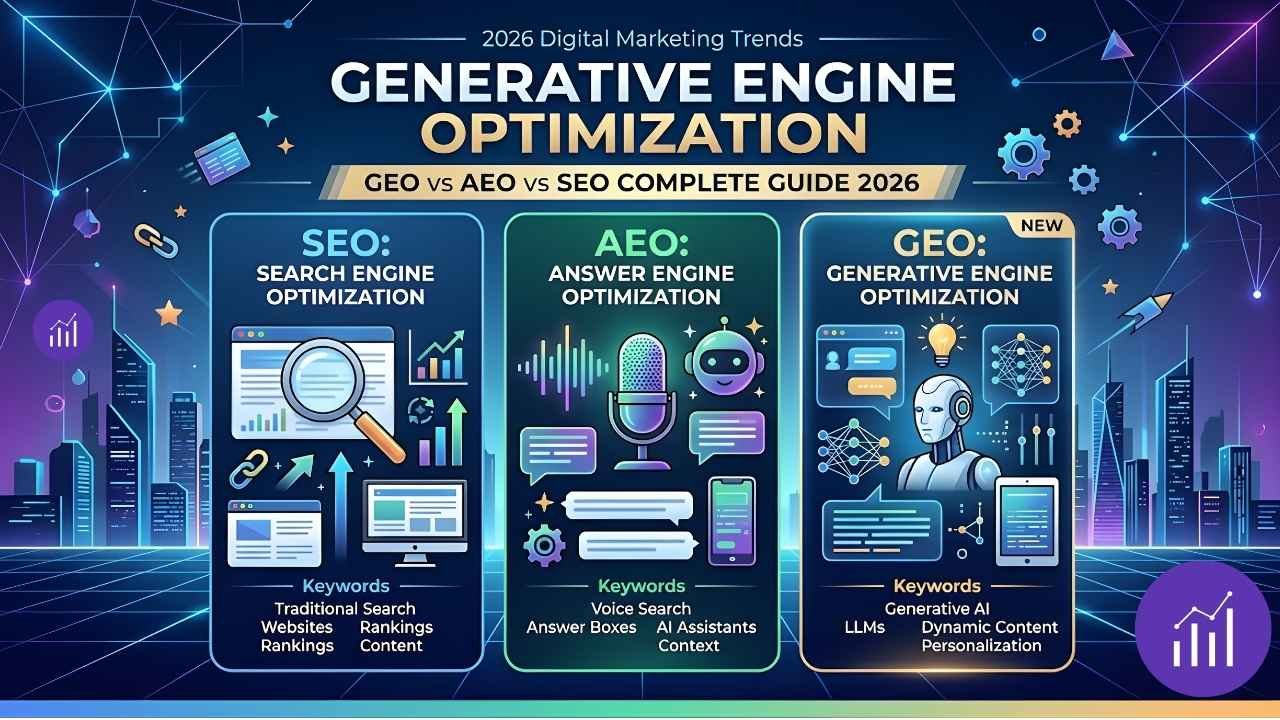
The Search Landscape Has Changed Forever
Remember when ranking #1 on Google was the ultimate goal? Those days are gone. Today, your potential customers are asking ChatGPT, Perplexity, and Google AI Overviews for recommendations – and they’re getting answers without ever visiting a website.
According to Ahrefs data, AI overviews have reduced traditional click-through rates by 34.5% in just one year. But here’s the opportunity: Similarweb data shows AI referrals surged 357% year-over-year, and these visitors convert 4.4x better than traditional traffic.
What is SEO (Search Engine Optimization)?
The Foundation That Still Matters
SEO remains the backbone of digital visibility. It’s about optimizing your content so search engines like Google and Bing can find, understand, and rank your pages.
Core SEO Elements in 2026:
- Technical SEO: Core Web Vitals (LCP <2.5s, INP <200ms, CLS <0.1), mobile optimization, site speed
- On-Page SEO: Title tags, meta descriptions, heading structure (H1, H2, H3), internal linking
- Off-Page SEO: Backlinks, brand mentions, authority signals
- Schema Markup: JSON-LD structured data for rich snippets
- E-E-A-T: Experience, Expertise, Authoritativeness, Trustworthiness
What is AEO (Answer Engine Optimization)?
Optimizing for Featured Snippets and AI Overviews
AEO focuses on formatting content so it appears in Google’s AI Overviews, featured snippets, and voice search results. It’s about being the direct answer to user questions.
Key AEO Strategies:
- Directness over cleverness: Lead with one-sentence answers
- Extraction-friendly structures: FAQs, tables, bullet points
- Machine-readable language: Clear, unambiguous phrasing
- Question-based headings: Mirror how users actually search
What is GEO (Generative Engine Optimization)?
The Future of Search Visibility
GEO is the practice of optimizing content so large language models like ChatGPT, Perplexity, Gemini, and Claude cite it as a trusted source. It’s about becoming the reference material AI uses to generate answers.
The GEO Philosophy: “GEO-First, SEO-Supported”
After analyzing 12+ expert repositories and running campaigns for 700+ clients, I’ve developed a clear framework:
1. Evidence-Based Authority
- Original research and data: First-party insights AI can’t find elsewhere
- Case studies: Real-world examples (like this article)
- Expert perspectives: Unique insights from industry experience
- Citations: Linking to authoritative sources
2. Clear Structure for AI Parsing
- Optimal passage length: 134-167 words per key point
- Self-contained sections: Each paragraph answers one question completely
- Semantic HTML: Proper heading hierarchy, clean code
- Entity optimization: Clear mentions of people, places, concepts
3. Transparency Signals
- Author bios: Clear expertise credentials (this is why I introduce myself upfront)
- Publication dates: Content freshness matters
- Edit history: Shows content evolution
- Contact information: Builds trust signals
Real-World Case Study: How I Optimized for GEO
Let me share a real example from my work at LinkBooster.
The Challenge:
A client in the digital marketing space wanted to be cited by AI systems when users asked about “SEO services for small businesses.”
Our GEO Strategy:
Step 1: Created Comprehensive Resource Pages
Instead of thin service pages, we built in-depth guides covering complete small business SEO checklists, cost breakdowns with real pricing data, platform-specific comparisons, and industry benchmarks we researched ourselves.
Step 2: Structured for Citation
We formatted content specifically for AI extraction: Each section 134-167 words, direct factual statements, clear headings mirroring user questions, bullet points for easy parsing.
Step 3: Built Authority Signals
Published author profiles with credentials, added publication dates and update history, included verifiable contact information, linked to our presence on freelance platforms (Legiit, Kwork reviews).
Step 4: Multi-Platform Presence
Active LinkedIn presence, industry forum participation, guest posts on recognized sites, Wikipedia citations where relevant.
The Results:
Within 6 months, the client started appearing in ChatGPT recommendations for small business SEO, Perplexity citations for pricing comparisons, and Google AI Overviews for service comparisons.
Most importantly, traffic from AI referrals converted 4.4x better than traditional organic traffic because these users had already been “pre-sold” by the AI recommendation.
GEO vs AEO vs SEO: How They Work Together
Think of these three disciplines as layers:
GEO Layer (AI citations & recommendations)
AEO Layer (Featured snippets & AI Overviews)
SEO Layer (Traditional search visibility)
The Complete Strategy:
SEO establishes baseline visibility – Without good SEO, AI systems won’t find your content in the first place.
AEO ensures accessibility – Makes your content extractable for answer boxes and AI Overviews.
GEO positions you as the trusted source – Gets you cited in AI-generated responses, even when users don’t click through.
Practical Implementation: Your 30-60-90 Day Roadmap
Days 1-30: Foundation
- Complete technical SEO audit (Core Web Vitals, mobile optimization)
- Implement proper schema markup (JSON-LD)
- Create author bio pages with credentials
- Add publication dates and last-modified dates
- Build llms.txt file (emerging standard for AI crawlers)
Days 31-60: Content Optimization
- Audit existing content for GEO potential
- Rewrite top 10 pages with 134-167 word passages
- Add FAQ sections to key pages
- Create comparison content (X vs Y formats)
- Build brand mention strategy
Days 61-90: Authority Building
- Launch original research or data studies
- Expand multi-platform presence
- Optimize for specific AI platforms
- Monitor AI citations and mentions
- Refine based on performance data
Key Mistakes to Avoid
After 700+ projects, here are the most common errors I see:
- Optimizing only for traditional SEO – Missing the AI shift entirely
- Thin content – AI systems need substance to cite
- No author transparency – Hurts E-E-A-T signals
- Ignoring brand mentions – Missing the 3x correlation opportunity
- Platform-agnostic approach – Different AIs have different preferences
Why This Matters for Your Business
Generative Engine Optimization isn’t just another marketing buzzword – it’s a fundamental shift in how people find information.
When ChatGPT recommends your business, when Perplexity cites your research, when Google AI Overview features your content – you’re not just getting traffic. You’re getting pre-qualified, high-intent traffic that converts.
At LinkBooster, we’ve seen AI-referred visitors convert at 4.4x the rate of traditional organic traffic. These users trust the AI’s recommendation, so they arrive with confidence.
The brands that master GEO in 2026 will dominate the next decade of search.