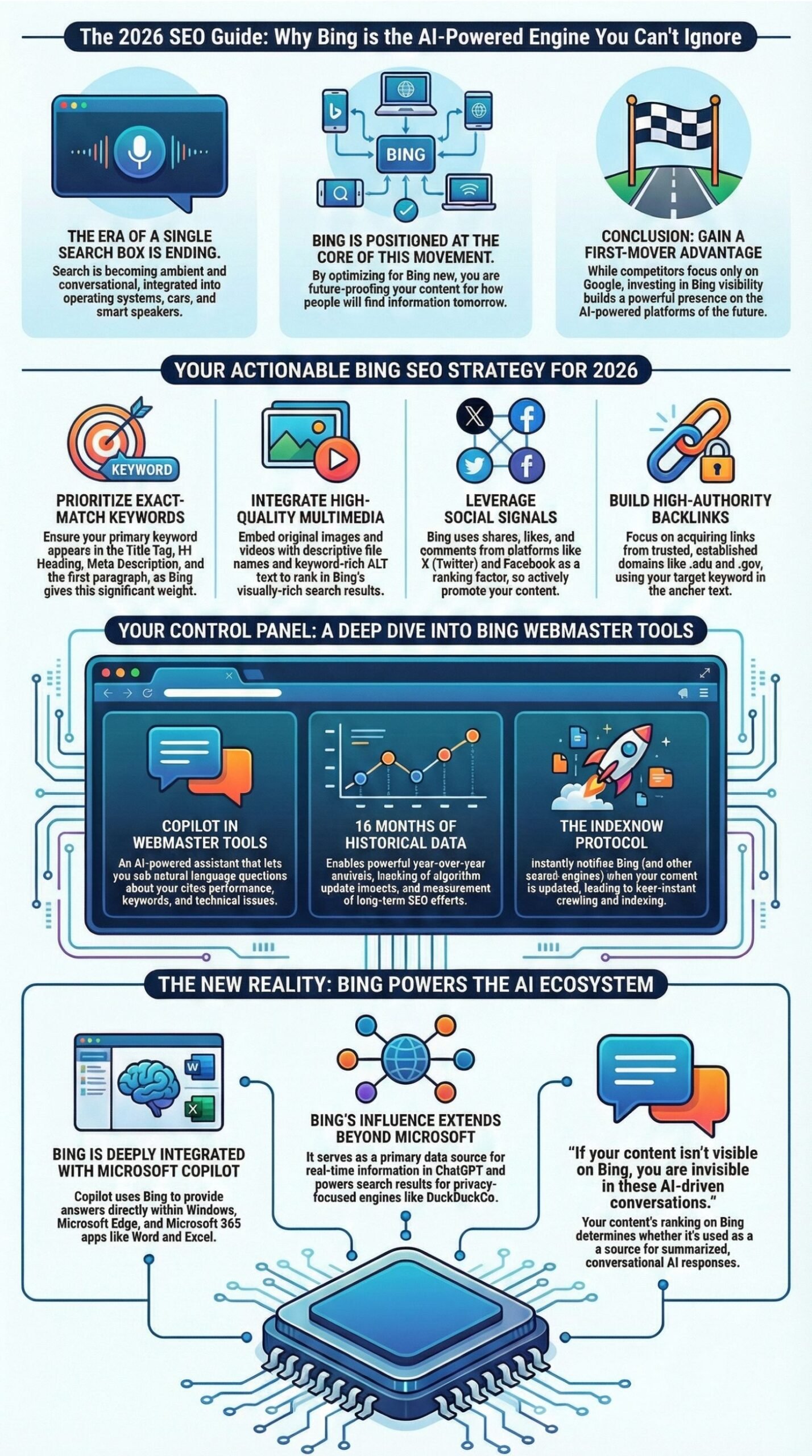
The 2026 SEO Guide: Why Bing Is the AI-Powered Engine You Can’t Ignore
For over a decade, the world of search has been dominated by one name: Google. As a result, digital marketers and businesses have poured their resources into mastering Google’s algorithm. But the digital landscape is undergoing a seismic shift, driven by artificial intelligence. And at the heart of this transformation is a player you might have underestimated: Bing.
Ignoring Bing in 2026 isn’t just a missed opportunity; it’s a strategic error. This isn’t about Bing “beating” Google in traditional search. It’s about recognizing that Bing has evolved. It is now the foundational data layer for a vast ecosystem of AI experiences, from operating systems to dedicated AI assistants.
This comprehensive guide will walk you through why Bing demands your attention, how to leverage its increasingly sophisticated tools, and how to build a future-proof SEO strategy that embraces the new era of AI-powered search.
Part 1: The Evolution of Bing—More Than a Search Engine
To understand Bing’s importance, you must first understand its new role. Bing is no longer just a website you visit to find information. It’s the engine powering conversational AI and intelligent assistants that millions of people use daily.
The Integration with Microsoft Copilot
The single biggest game-changer is Bing’s deep integration with Microsoft Copilot. Copilot is not just an app; it’s woven into the fabric of Microsoft’s most popular products:
- Windows: Copilot is integrated directly into the Windows operating system. Users can ask complex questions right from their desktop, and Copilot, powered by Bing, provides answers without even opening a browser.
- Microsoft Edge: The Edge browser has a built-in Copilot sidebar, encouraging users to “chat” with the web. It can summarize articles, compare products, and answer questions using information sourced by Bing.
- Microsoft 365 (Office): Copilot is being integrated into Word, Excel, PowerPoint, and Outlook to help users create, analyze, and communicate. When it needs real-time information from the web, it turns to Bing.
What this means for you: When a user asks Copilot, “What are the best noise-canceling headphones for under $200?”, the answer isn’t just a list of links. It’s a summarized, conversational response built from the top-ranking content on Bing. If your content isn’t visible on Bing, you are invisible in these AI-driven conversations.
Powering the Wider AI Ecosystem
Bing’s influence extends far beyond Microsoft’s own products.
- ChatGPT: While ChatGPT uses its own model, for real-time information and browsing capabilities, it often relies on Bing’s search index to provide up-to-date answers.
- DuckDuckGo: The privacy-focused search engine DuckDuckGo uses Bing’s index as a primary source for its search results.
- AI Assistants: Other voice and text-based assistants use Bing’s API to answer user queries that require web access.
Every time one of these services answers a question using web data, there’s a high chance Bing is working behind the scenes. Your visibility on Bing is no longer about one website; it’s about being the source of truth for countless AI interactions.
Part 2: A Deep Dive into Bing Webmaster Tools
If Bing is the engine, then Bing Webmaster Tools is your dashboard and control panel. Microsoft has been investing heavily in this platform, turning it into a powerful, data-rich resource that, in some ways, is becoming even more user-friendly than its Google counterpart.
Key Features You Must Master:
-
Copilot in Bing Webmaster Tools: This is your personal AI-powered SEO consultant. Instead of just looking at data charts, you can ask it direct questions in natural language, such as:
- “Why did my organic traffic drop last month?”
- “Which keywords are bringing me the most clicks but have a low CTR?”
- “Give me a list of pages with technical SEO issues.” This feature dramatically lowers the barrier to entry for SEO analysis, making it easier to find actionable insights.
-
16-Month Data History: Data is power, and more data is more power. Bing Webmaster Tools now offers 16 months of historical data. This is a huge advantage for:
- Year-over-Year Analysis: You can compare your performance this November to last November to understand seasonal trends accurately.
- Tracking Algorithm Updates: You can look back over a year to see how major Bing updates may have impacted your site.
- Measuring Long-Term SEO Efforts: See the true impact of a content strategy or technical fix that took months to show results.
-
The IndexNow Protocol: This is perhaps one of the most significant recent innovations in search. IndexNow is an open protocol (also adopted by Yandex and others) that allows you to instantly notify search engines when your content has been updated.
- How it Works: When you publish a new blog post or update a page, your CMS or a plugin can automatically “ping” the IndexNow API.
- The Benefit: Instead of waiting for Bing’s crawler (Bingbot) to discover your changes, you are telling it directly. This leads to near-instant crawling and indexing, which is critical for time-sensitive content like news or event listings. Many popular platforms and SEO plugins (like Yoast and Rank Math) now have built-in IndexNow integration.
Part 3: Your Actionable Bing SEO Strategy for 2026
Optimizing for Bing shares many principles with Google SEO (quality content is still king), but Bing has its own nuances. Focusing on these can give you a competitive edge.
Step 1: On-Page SEO with a Bing-Specific Focus
- Keywords Matter (A Lot): While Google has moved towards semantic understanding, Bing still places significant weight on exact-match keywords.
- Action: Ensure your primary target keyword appears in your Title Tag, H1 Heading, Meta Description, and within the first paragraph of your content. Don’t stuff keywords, but be direct.
- Multimedia Content: Bing’s search results are often more visual than Google’s, featuring prominent image and video carousels.
- Action: Embed high-quality, original images and videos in your content. Use descriptive file names (e.g.,
bing-seo-guide-2026.jpg) and fill out your ALT text with relevant keywords. This increases your chances of appearing in both web and media search results.
Step 2: Technical SEO for Bing
- Submit Your Sitemap: This is fundamental. Go to Bing Webmaster Tools, and under ‘Sitemaps’, submit your sitemap URL (usually
yourdomain.com/sitemap.xml). This gives Bing a clear roadmap of all the pages on your site.
- Embrace IndexNow: As discussed, this is your fast pass to getting indexed. Check if your CMS or SEO plugin supports IndexNow and enable it.
- Social Signals: Bing has been more open about using social signals as a ranking factor. It sees shares, likes, and comments on platforms like X (Twitter), Facebook, and LinkedIn as a sign of authority and relevance.
- Action: Actively promote your content on social media. Ensure your website has prominent social sharing buttons to encourage readers to share your articles.
Step 3: Off-Page SEO (Link Building)
- Trust and Age: Bing appears to place a higher value on backlinks from old, established, and trusted domains (.edu and .gov domains are gold). A single, high-authority link can have a significant impact.
- Anchor Text: Similar to its keyword philosophy, Bing pays close attention to the anchor text of your backlinks. Having backlinks with your target keyword in the anchor text is highly beneficial.
Final Thoughts: The Future is Searched Everywhere
The era of a single search box is ending. The future of search is ambient, conversational, and integrated into the tools we use every day. People are “searching” when they talk to their operating system, their car, or their smart speaker.
Bing is strategically positioned at the core of this “Search Everywhere” movement. By investing in your Bing visibility now, you are not just optimizing for a search engine. You are optimizing for the future of how people will find information. While your competitors remain fixated solely on Google, you have the opportunity to build a powerful presence on the AI-powered platforms of tomorrow, gaining a crucial first-mover advantage.